
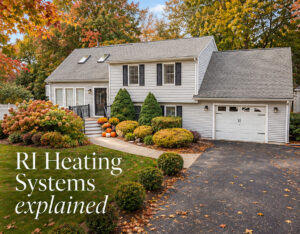

A Rhode Island Homebuyer’s Guide to Oil, Gas, Electric Heat, Heat Pumps, Zoning, Fireplaces, Wood Stoves, Energy Efficiency and Solar
Buying a home in Rhode Island means looking at much more than the number of bedrooms, the kitchen, or the neighborhood. One of the most important systems to understand before buying a Rhode Island home is the heating system.
Rhode Island homes range from historic properties and traditional Cape Cods and Colonials to ranches, split-levels, multifamily homes, condominiums, coastal properties, and new construction. Because Rhode Island has such a diverse housing stock, buyers can encounter many different heating systems, and the age or architectural style of a home does not automatically determine what heating system it has today.
Peter Almonte Jr., an experienced Rhode Island real estate professional with more than 30 years in the industry, believes buyers should understand the entire property—not just the asking price.
“When you’re buying a home in Rhode Island, you want to understand how the home operates, what it will cost to maintain, and what opportunities you may have to improve it over time. Heating is an important part of that conversation.” — Peter Almonte Jr.
What heating systems are common in Rhode Island homes?
Common heating systems in Rhode Island homes include oil-fired boilers and furnaces, natural gas boilers and furnaces, propane heating, electric resistance heating, air-source heat pumps, ground-source heat pumps, and hydronic heating systems.
Rhode Island’s older housing stock means buyers will encounter a particularly wide range of heating equipment. A historic Providence home may have a boiler and radiators, while a postwar ranch may have an oil-fired system with baseboard heat, and a newer home may use a heat pump or high-efficiency gas system.
The most important point for a buyer is that the home’s age and style are clues, not guarantees.
A buyer should always determine what equipment is actually installed, how old it is, how it has been maintained, what fuel it uses, and how much energy the property historically consumes.
Does the year a Rhode Island home was built determine its heating system?
No, the year a Rhode Island home was built does not reliably determine its current heating system because many homes have had their original heating equipment replaced or converted.
Older homes may have originally been designed around fireplaces, coal, wood, or early boiler systems but later converted to oil, gas, propane, or electricity.
A 1950s Cape Cod might have oil heat, while another 1950s Cape Cod could have natural gas or a heat pump.
The architectural style can tell you something about how a home was originally designed, but the current heating equipment should always be verified independently.
What should you ask about the heating system when buying a Rhode Island home?
A Rhode Island home buyer should ask about the type, age, maintenance, operating cost, fuel source, efficiency, and replacement history of the home’s heating system.
Important questions include:
- What type of heating system is installed?
- What fuel does it use?
- How old is the furnace or boiler?
- When was it last serviced?
- Are service records available?
- What were the previous owner’s heating costs?
- Does the system also heat domestic water?
- How many heating zones does the home have?
- Are there separate thermostats?
- Has the system been replaced or upgraded?
- Is there a service contract?
- Is any equipment under warranty?
- Are there known problems with the system?
A buyer should also have the heating system evaluated as part of the home inspection process and, when appropriate, by a qualified heating professional.
What should buyers know about oil heat in Rhode Island?
Oil heating remains an important heating source in Rhode Island, particularly in older homes and properties where natural gas service is unavailable.
The Rhode Island Office of Energy Resources reports that approximately one-third of Rhode Islanders use heating oil for home heating.
Oil can be a dependable heating source, but buyers should understand that heating oil prices can fluctuate, which can make winter heating costs less predictable.
When purchasing a Rhode Island home with oil heat, buyers should ask about:
- Boiler or furnace age
- Oil tank age and condition
- Above-ground versus underground tank
- Recent oil deliveries
- Annual oil consumption
- Maintenance history
- Service contracts
- Previous heating bills
- Whether the oil system also heats domestic water
Buyers should pay particular attention to the oil tank because replacing or remediating an aging or leaking tank can become an expensive issue.
Can Rhode Island homeowners put their oil heating on a monthly budget?
Yes, many Rhode Island heating-oil companies offer budget or level-payment programs that spread estimated annual heating costs over monthly payments.
Budget billing can help homeowners avoid a situation where winter fuel expenses create dramatically larger monthly household expenses.
A budget plan changes when you pay for the fuel rather than necessarily changing the underlying cost of the fuel.
Buyers should therefore look at actual historical usage and fuel consumption rather than assuming a monthly budget plan means the home is inexpensive to heat.
What should buyers know about electric heat in Rhode Island?
Electric heat can mean several different things, so buyers should identify exactly what type of electric heating system the home uses.
Electric resistance heating may include electric baseboards, wall heaters, radiant systems, or other equipment.
Heat pumps are also powered by electricity, but they operate differently by transferring heat rather than producing heat through electrical resistance.
A home heated by electric resistance and a home heated primarily by modern heat pumps should not be evaluated as though they are the same system.
Buyers should request historical electric usage when possible and determine whether electricity is used for heating, cooling, hot water, appliances, or all of the above.
Can electric heating costs be put on a monthly budget?
Yes, homeowners can ask their electric utility about available budget or level-payment programs that can make monthly expenses more predictable.
However, buyers should still investigate the home’s actual energy consumption because a predictable payment does not necessarily mean the home is energy efficient.
What should buyers know about natural gas heating?
Natural gas heating is commonly found in Rhode Island homes with furnaces, boilers, water heaters, fireplaces, and other gas appliances.
A buyer should determine whether the property has natural gas service and whether the home’s heating equipment is a gas furnace, gas boiler, or another type of system.
The age and maintenance history of the gas equipment are more important to evaluate than simply knowing that the property has gas heat.
What should buyers know about propane heating?
Propane can be used to fuel furnaces, boilers, fireplaces, water heaters, and other appliances in Rhode Island homes.
Buyers should determine whether a propane tank is owned or leased and should understand the terms associated with the tank before closing.
A buyer should also review propane usage and delivery records to understand the property’s historical energy consumption.
What is hydronic heating in a Rhode Island home?
Hydronic heating uses heated water to distribute warmth through radiators, baseboards, radiant floors, or other systems.
Hydronic systems are common in many older Rhode Island homes and can provide consistent, comfortable heat.
When buying a home with hydronic heating, buyers should have the boiler, piping, valves, circulator pumps, expansion tank, and other components evaluated for condition and age.
What is forced-air heating?
Forced-air heating uses a furnace to heat air and distribute it through ductwork throughout the home.
Forced-air systems can be particularly convenient because the same ductwork may also serve a central air-conditioning system.
Buyers should inspect the furnace and ask about the condition of the ductwork, airflow, filtration, maintenance history, and age of the equipment.
Why are heating zones important in a Rhode Island home?
Heating zones allow different areas of a home to be heated independently rather than maintaining the same temperature throughout the entire property.
A larger Rhode Island home might have one zone for the first floor, another for the bedrooms, and another for a finished lower level.
Multiple zones can improve comfort and give homeowners greater control over how different parts of the house are heated.
Can heating zones be added to an existing Rhode Island home?
Additional heating zones may be possible, but the feasibility depends on the home’s heating system, layout, piping, ductwork, controls, and electrical infrastructure.
For example, adding zones to a hydronic baseboard system is different from zoning a forced-air system.
A heating contractor should evaluate the existing system before a buyer assumes that zoning can easily be added.
Are fireplaces a good source of heat in a Rhode Island home?
A traditional open fireplace should generally be viewed as a supplemental or recreational feature rather than automatically assuming it is an efficient primary heating source.
An open fireplace can provide warmth and ambiance, but much of the heat can escape through the chimney.
Buyers should determine whether a fireplace is decorative, functional, or designed to provide meaningful supplemental heat.
Is a wood-burning stove different from a fireplace?
Yes, a properly installed wood-burning stove or insert is designed differently from an open fireplace and can provide more controlled supplemental heat.
Buyers should ask whether the stove is approved for use, whether it has been professionally installed, and whether the chimney and flue have been properly maintained.
A chimney inspection and cleaning should be considered before relying on a wood-burning appliance for heating.
What should buyers check when a Rhode Island home has a fireplace or wood stove?
Buyers should investigate the condition, safety, installation, and maintenance history of any fireplace or wood-burning appliance before purchasing the home.
Questions should include:
- When was the chimney last inspected?
- When was it last cleaned?
- Is there a chimney liner?
- Is the appliance permitted?
- Are installation records available?
- Is the wood stove EPA-certified?
- Are there signs of water intrusion?
- Is the chimney shared with another appliance?
- Is the fireplace intended for regular heating or primarily for ambiance?
A fireplace can be a wonderful feature in a Rhode Island home, but buyers should understand exactly what it can and cannot do.
How important is insulation when buying a Rhode Island home?
Insulation is extremely important because the efficiency of a home’s heating system is affected by how well the building retains heat.
A newer furnace or heat pump cannot completely overcome significant heat loss through poorly insulated walls, attics, foundations, windows, doors, or other parts of the building envelope.
Buyers should ask about insulation levels and pay attention to attics, basements, crawl spaces, exterior walls, windows, doors, and areas around ducts and pipes.
What should buyers know about heating costs before buying a Rhode Island home?
Buyers should consider historical heating and utility costs as part of the property’s overall cost of ownership.
Two Rhode Island homes with identical purchase prices can have very different monthly expenses because of differences in square footage, insulation, windows, heating fuel, equipment efficiency, thermostats, water heating, and energy use.
When possible, buyers should ask the seller or utility provider for historical consumption information rather than trying to estimate heating costs from the asking price or size of the home alone.
Are heat pumps a good future option for Rhode Island homes?
Heat pumps are an increasingly important option for Rhode Island homeowners because they can provide both heating and cooling while using electricity to transfer heat rather than generating heat through combustion.
The Rhode Island Office of Energy Resources identifies air-source and ground-source heat pumps among the state’s home heating and cooling options.
Whether a heat pump is appropriate for a particular home depends on factors including insulation, home size, layout, electrical capacity, existing heating equipment, ductwork, and the homeowner’s goals.
A buyer does not necessarily need to replace an existing heating system immediately.
A more practical long-term strategy may be to improve insulation and efficiency first, then consider heat pumps or other upgrades as existing equipment reaches the end of its useful life.
Can solar help with a Rhode Island home’s energy costs?
Solar can be part of a long-term energy strategy for a Rhode Island homeowner, particularly when paired with efficient electric systems such as heat pumps.
Rhode Island has renewable-energy programs that can provide incentives or credits for qualifying systems, including net-metering programs and the state’s Renewable Energy Fund programs.
Solar incentives, rebates, tax credits, utility programs, and eligibility requirements can change, so buyers should verify current programs before making a financial decision.
When evaluating a home with existing solar panels, buyers should also determine whether the system is owned, financed, or leased and whether any agreement transfers with the property.
What should buyers ask about solar panels on a Rhode Island home?
A buyer should understand who owns the solar equipment, how the system was financed, how much electricity it has historically generated, and what agreements or obligations transfer with the property.
Important questions include:
- Are the panels owned or leased?
- Is there a solar loan?
- Is there a remaining balance?
- What warranties transfer?
- How old is the system?
- What has it produced historically?
- What is the condition of the roof?
- What utility program is the system enrolled in?
- What happens to the solar agreement when the property is sold?
Solar should be evaluated as part of the entire home and financial picture rather than simply treated as a selling feature.
What does the future of home heating look like in Rhode Island?
Rhode Island’s residential energy landscape is moving toward greater energy efficiency, electrification, heat pumps, improved insulation, renewable energy, and more efficient home systems.
That does not mean every Rhode Island homeowner needs to immediately replace an oil, gas, or electric system that is functioning properly.
The better question for a buyer is whether the home provides opportunities to improve efficiency over time.
Those improvements could include:
- Better attic insulation
- Air sealing
- Improved windows
- Smart thermostats
- Additional heating zones
- Heat pumps
- Heat-pump water heaters
- Solar
- High-efficiency heating equipment
- Improved electrical capacity
Rhode Island has programs supporting energy efficiency and clean heating improvements, although availability and eligibility can change.
Does the heating system affect the value of a Rhode Island home?
The heating system can influence how buyers evaluate a property because operating costs, equipment age, efficiency, and future replacement needs are part of home ownership.
However, there is no universal heating system that automatically makes one Rhode Island home more valuable than another.
A buyer’s priorities, the property’s location, condition, size, construction, insulation, utility costs, and overall market position all matter.
Should you avoid buying a Rhode Island home with oil heat?
No, the presence of oil heat alone is not a reason to automatically reject a Rhode Island home.
Oil-heated homes are common throughout Rhode Island, and many have reliable, well-maintained systems.
The important questions are the condition and age of the equipment, the condition of the oil tank, historical fuel consumption, maintenance history, and the cost and feasibility of future upgrades.
Should you avoid buying an older Rhode Island home?
No, an older Rhode Island home should be evaluated based on its actual condition rather than its age alone.
Older Cape Cods, Colonials, Victorians, ranches, and other traditional homes can offer character, established neighborhoods, mature landscaping, larger lots, and architectural details that buyers value.
The key is understanding the home’s major systems—including heating, electrical, plumbing, roof, foundation, insulation, and windows—before making a purchase decision.
What is Peter Almonte Jr.’s advice to Rhode Island home buyers?
Peter Almonte Jr.’s advice is to look at the entire property and understand what you are buying before making one of the largest financial commitments of your life.
“Don’t just fall in love with the kitchen or the backyard. Understand the house. Know how it is heated, what it costs to operate, what needs attention, and what you can improve over time.” — Peter Almonte Jr.
A knowledgeable Rhode Island real estate professional can help buyers identify the questions that need to be asked, while inspectors and qualified contractors can provide the technical evaluations of the property’s systems.
Buying or Selling a Rhode Island Home? Talk to Trusthill Real Estate.
Trusthill Real Estate helps Rhode Island buyers and sellers navigate properties across a wide range of budgets, home styles, communities, and real estate goals.
From a first-time buyer purchasing a starter home to someone moving into a luxury property, downsizing, purchasing an investment property, or selling a longtime family home, the details matter.
Trusthill’s experienced Rhode Island real estate professionals can help you understand the property, the neighborhood, the transaction, and the questions you should be asking before you make your move.
If you’re thinking about buying six months from now, next year, or even further down the road, you don’t have to wait until you’re ready to make an offer to start the conversation.
Call Trusthill Real Estate at (401) 884-5445 and talk with a Rhode Island real estate professional about your next move.
Rhode Island Real Estate Expertise for Every Home. Every Budget. Every Stage of Life.

401-391-1444
or by email at [email protected]
